

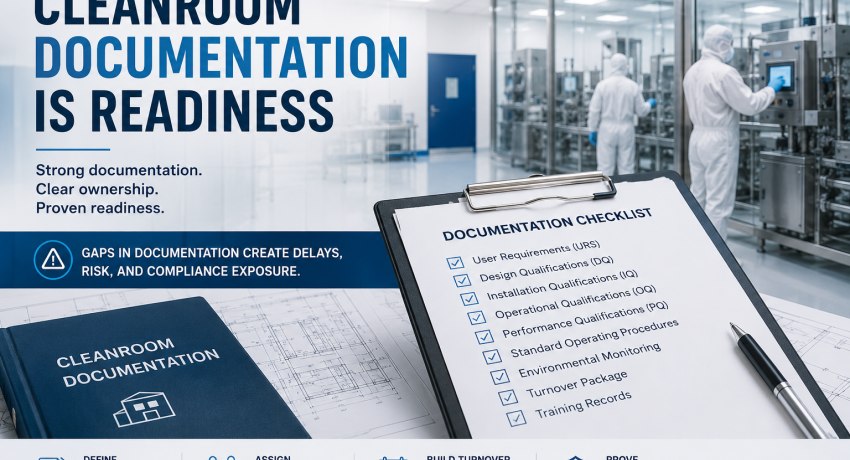
The facility is built. The cleanroom is classified. The equipment is installed. And the project is still months from operational readiness because no one can locate the records the quality team needs.
This scenario is common enough that it should be a planning assumption, not a surprise. For sterile manufacturing projects, documentation that arrives late, arrives incomplete, or was never clearly assigned does not stay a paperwork problem. It becomes a schedule problem, a compliance problem, and sometimes an inspection problem.
Classification Is Not Readiness
FDA has been explicit on this point. Its CGMP Q&A on production and process controls states that manufacturers of sterile drug products cannot rely solely on ISO 14644-1 and ISO 14644-2 to qualify their aseptic processing facilities. FDA expects those standards to be applied alongside applicable regulations, guidance, microbiological data, process validation, and demonstrated state-of-control evidence. (FDA, Questions and Answers on Current Good Manufacturing Practices: Production and Process Controls)
ISO classification confirms particle-count performance under defined test conditions. It does not confirm that the facility layout supports aseptic operations, that personnel and material flows reduce contamination risk, that written procedures reflect the installed condition, or that the operations team can run the process in a controlled, repeatable way.
Recent enforcement reflects this gap. In April 2026, FDA cited a sterile injectable contract manufacturer for deficiencies in aseptic processing cleanroom layout, protection of ISO 5 areas, excessive manual interventions, and inadequate written procedures for microbiological contamination control. The cleanroom existed. The documentation and contamination control strategy did not hold together.
The Market Is Moving Faster Than Most Documentation Strategies
U.S. sterile manufacturing investment is accelerating. AbbVie announced a $1.4 billion pharmaceutical manufacturing campus in Durham, North Carolina, including small volume parenteral manufacturing facilities, with construction starting in 2026 and completion expected by the end of 2028. Johnson & Johnson announced more than $1 billion for a next-generation cell therapy facility in Montgomery County, Pennsylvania. (AbbVie press release, April 22, 2026; J&J press release, February 18, 2026)
Expansion at this pace compresses timelines. Owners must define requirements, select vendors, manage scope, build quality systems, and prepare operations teams while design and construction run in parallel. Documentation gaps that form early do not stay small. They surface during bid leveling, commissioning, turnover, and inspection preparation, when correction costs the most.
Where Documentation Loses Control
The failure point is almost always the same: documentation was not part of the project structure. It was added to the project.
A URS that lists room classifications and utility requirements without defining process flow, contamination control logic, or operating assumptions produces vendor bids built on different assumptions. That gap becomes a change order. An RFP that does not specify GMP documentation deliverables, testing support, or turnover records transfers those decisions to vendors who did not price them. A turnover plan treated as a closeout task leaves the owner reconstructing the project history at the moment the quality team needs it organized and complete.
The result is predictable: delayed startup, incomplete turnover packages, procedures that do not reflect the installed condition, and inspection-readiness gaps that could have been closed months earlier.
What Owners Should Decide Before Procurement Advances
Three decisions made early carry disproportionate weight on sterile manufacturing projects.
Define the process before defining the room. A URS built around process flow, personnel and material movement, contamination risks, and operating assumptions produces better vendor responses and fewer scope disputes than one built around room classifications alone.
Assign documentation ownership in the RFP. GMP documentation deliverables, testing support, turnover records, and interface management responsibilities belong in the bid package. If they are not assigned, they will not arrive on time, in consistent formats, or with the context the quality team needs.
Build turnover into the project schedule, not the project closeout. By turnover, the documentation package should confirm readiness, not being assembled for the first time.
Contact Hygenix Before the Project Locks In
Hygenix supports pharmaceutical manufacturers and biotech companies with cGMP documentation, URS and RFP development, vendor selection, and cleanroom project execution support from planning through operational readiness.
The most valuable time to engage is before procurement is underway and before design decisions lock in documentation gaps that become expensive to unwind. That is when requirements can still be defined clearly, vendor scope can be structured to reduce ambiguity, and the turnover path can be built into the project rather than added to it.
If your team is planning or executing a sterile manufacturing cleanroom project and documentation strategy has not been part of the conversation yet, contact Hygenix now. That conversation is easier to have before the RFP goes out than after the bids come back.